
SEO & PPC Management: Why the Smartest Companies Run Both Together
by Michael Santiago, Fullstack Developer & SEO
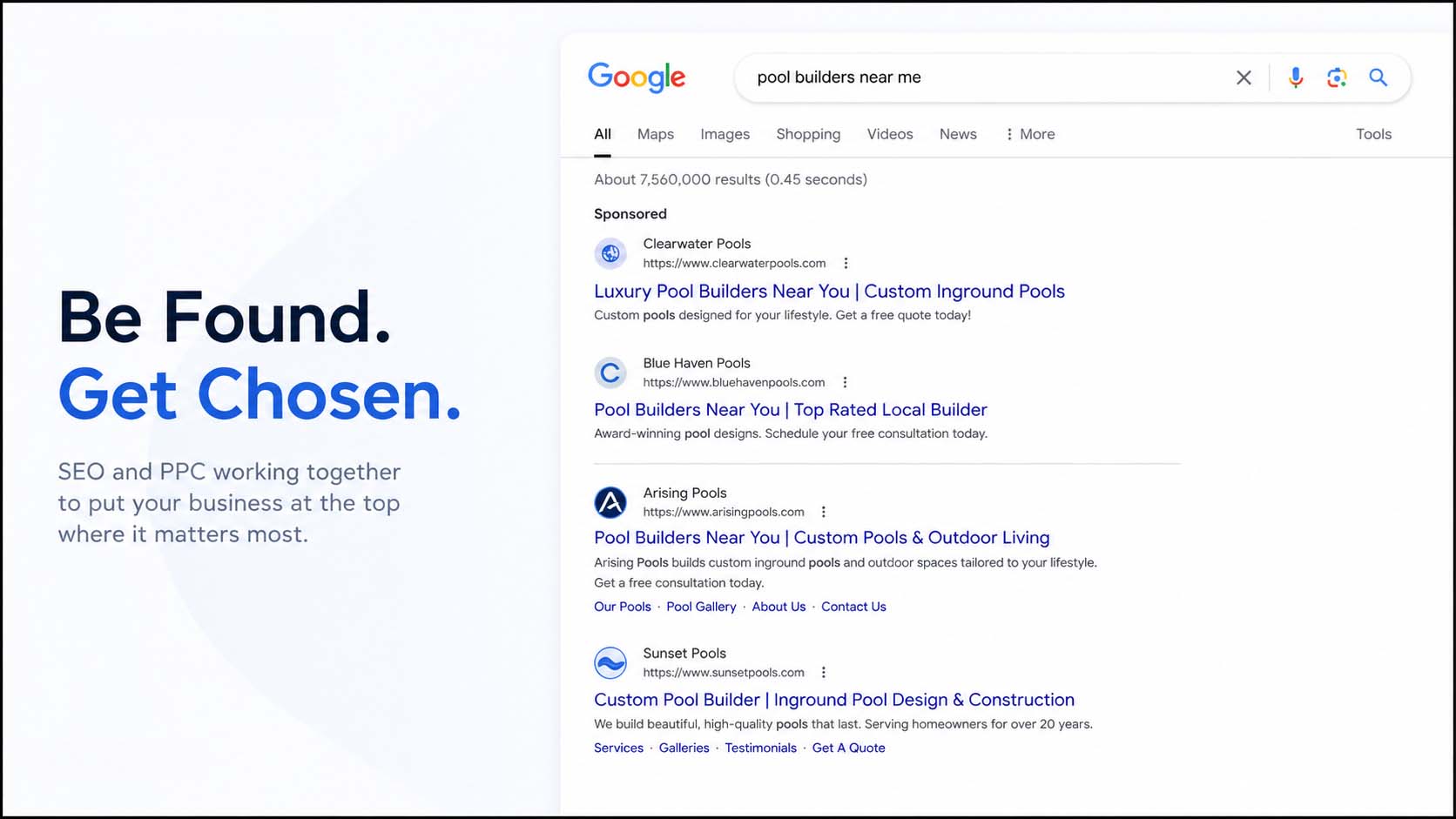
One Search Page, Two Ways to Win It
Every day your customers type their problem into Google. What they see back is a single page with two kinds of results: paid ads at the top and organic listings underneath. Most companies pick one lane. They run ads or they invest in SEO, and they quietly hand the other lane to a competitor.
The companies that grow fastest don't choose. They treat SEO and PPC management as one integrated system, where each channel feeds the other: paid campaigns generate instant data and immediate leads, while organic rankings compound into a durable, low-cost lead source. Run together, they don't just add. They multiply.
That's not theory for us. It's exactly how the Springhetti Group accomplished 34x ROI by choosing us for their digital marketing. This article breaks down how the synergy works, the specific plays we use, and how to structure it for your own business.
SEO vs. PPC: What Each Channel Actually Does Best
Before combining them, it helps to be honest about what each one is good at, and where each one falls short:
| SEO (Organic Search) | PPC (Paid Search) | |
|---|---|---|
| Speed to results | 3–12 months to build | Traffic within days |
| Cost model | Upfront investment, compounding returns | Pay for every click, forever |
| When you stop paying | Rankings and traffic persist | Traffic stops immediately |
| Data feedback | Slow (weeks to validate a keyword) | Fast (know in days what converts) |
| Trust factor | Higher (users trust organic results) | Lower, but it wins the top position |
| Targeting control | Limited to what you rank for | Precise: keywords, geography, schedule, audience |
Read that table again and the strategy writes itself: PPC's weaknesses are SEO's strengths, and vice versa. PPC is expensive but fast and precise. SEO is slow but durable and compounding. A company running both has no exposed flank.
The 5 Synergy Plays That Make 1 + 1 = 3
1. Let PPC Do Your Keyword Research With Real Money on the Line
Traditional keyword research is educated guessing: search volumes, difficulty scores, intent assumptions. PPC replaces guessing with proof. Within weeks, your search term reports show exactly which queries produce leads and what a customer costs from each one.
Those proven converters become your SEO hit list. Instead of spending six months ranking a page for a keyword that might convert, you build content around keywords that already have. This is the single biggest efficiency gain of integrated management: your SEO investment only chases keywords with demonstrated ROI.
2. Double Up on the SERP for Your Money Keywords
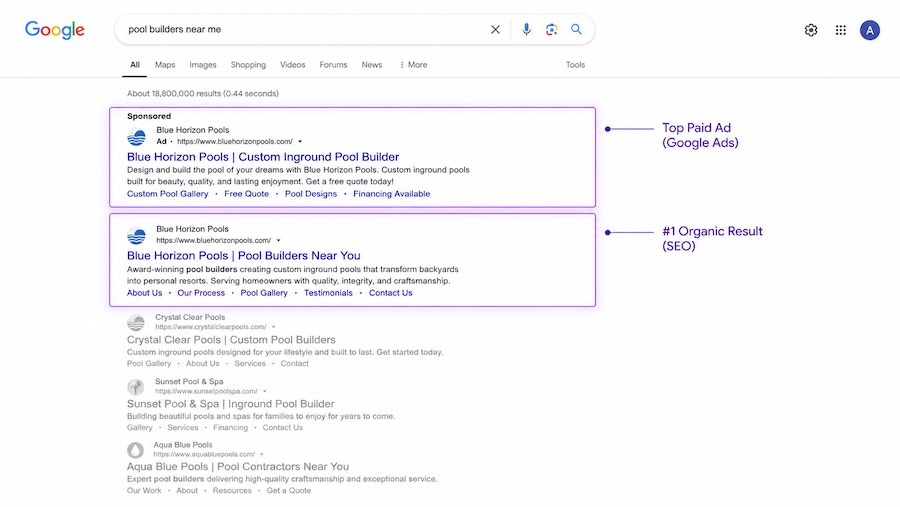
When your ad sits at the top of the page and your site ranks organically below it, two things happen: you physically occupy more of the screen, and searchers see your brand twice before they see a competitor once. Studies of paired paid-and-organic listings consistently show higher combined click-through rates than either listing earns alone, and a measurable share of those clicks are ones a solo listing would have lost.
Just as important: dominating both positions pushes competitors below the fold on the exact searches that make you money.
3. Cover the Gaps While the Other Channel Works
Every search strategy has coverage holes:
- New keywords you don't rank for yet? Run ads on them while the SEO catches up, then dial the ad spend down as organic takes over and reinvest it in the next target.
- Ranking #1 organically for a term? Consider reducing paid bids there and moving budget to keywords where you're invisible.
- Seasonal spike or a new service launch? PPC scales up in an afternoon; SEO can't. Paid fills the surge while your content strategy builds the permanent asset.
This "handoff" motion, with paid leading and organic replacing it, is where integrated management saves real money. Two separate vendors almost never do this, because neither can see the other's data.
4. Retarget the Traffic SEO Earns
Most organic visitors don't convert on the first visit. They're still researching. Without PPC, that traffic simply evaporates. With integrated management, every blog reader and service-page visitor your SEO attracts becomes a retargeting audience: your display and search ads follow up with the exact people who already know you, at a fraction of cold-traffic costs.
Your content marketing stops being a leaky bucket and becomes the top of a managed funnel.
5. Share Conversion Data to Optimize Everything
A/B tests on paid landing pages reveal headlines, offers, and layouts that convert, insights you can apply directly to your organic pages. Meanwhile, organic engagement data (what people read, where they scroll, what they search next) sharpens ad copy and audience targeting. One feedback loop, both channels improving. This is the same conversion rate optimization discipline we bake into every website we build and manage.
Case Study: How This Drove a 34x ROI for Springhetti Group
This isn't a hypothetical framework. It's the exact playbook behind one of our strongest client results.
Springhetti Group came to us for a website revamp. What they got was an integrated growth engine: a high-converting site, ongoing SEO to capture high-intent organic traffic, precision PPC campaigns engineered for lead quality over lead volume, and continuous conversion rate optimization informed by data from both channels.
The outcome: 34x ROI, accomplished by choosing us.
The synergy was the multiplier. PPC conversion data told us which pages and keywords deserved SEO investment. Organic behavior data told us how to refine the ad targeting. And the CRO program, fed by both, kept raising the conversion rate on every visitor, paid or organic. Today, that data is powering a second, even more precisely targeted redesign.
Read the full breakdown in the Springhetti Group case study.

What Integrated SEO & PPC Management Looks Like Month to Month
If you hire one team to run both channels, here's the operating rhythm you should expect:
- Month 1: Audit & foundation. Full technical SEO audit, keyword and competitor research, analytics and conversion tracking setup, and PPC account build (or rescue). No ad dollar is spent until tracking proves where it goes.
- Months 2–3: Paid data collection, organic groundwork. Campaigns go live and start producing leads and search-term data. Meanwhile, on-page SEO fixes ship and the first content targets, chosen partly from early ad data, go into production.
- Months 3–6: The feedback loop engages. Proven PPC converters become SEO priorities. Landing page tests raise conversion rates for both channels. Negative keyword lists and bid strategies get refined weekly.
- Months 6–12: Rebalancing for efficiency. As organic rankings capture money keywords, paid budget shifts to new fronts: new services, new geographies, retargeting, or competitor terms. Total cost per lead trends down while total lead volume trends up.
That last line is the whole point of the integrated model: the blended cost per lead should fall every quarter, because an increasing share of your leads arrive through rankings you already paid to build.
Want to model what this looks like for your budget? Our SEO cost calculator gives you a realistic starting figure in about a minute for SEO along. PPC costs are more complex, but we've got you covered with our PPC management services. When bundled together, they're a powerful tool for any business (and we'll provide you with a bundled quote).
The Cost of Running Them Separately
We regularly audit accounts where SEO and PPC are handled by different vendors (or one vendor and one overworked in-house marketer). The same expensive patterns show up almost every time:
- Paying for clicks on keywords the site already ranks #1 for, with no test to see if the spend is incremental.
- SEO teams writing content for keywords the ad account already proved don't convert.
- Two different landing pages for the same service, splitting conversion data and confusing Google's Quality Score.
- No retargeting on organic traffic, so the most affordable audience the business owns is never followed up with.
- Two reports, two narratives, and no answer to the only question that matters: what does a lead actually cost us, all-in?
Each one is invisible from inside a silo, and each one quietly taxes the budget. Integration isn't a nice-to-have. It's the elimination of a standing waste stream.
Where Local Search Fits In
For local service businesses, the paid-plus-organic playbook has a third layer: Local Services Ads and the Google Verified badge, which sit above even the traditional ads. If you serve a local market, pairing LSAs with SEO and PPC lets you appear up to three times on a single results page. We cover the badge, the screening process, and how the pay-per-lead billing works in our Google Verified and Local Services Ads guide.
Frequently Asked Questions
What is SEO and PPC management?
SEO and PPC management is the coordinated planning, execution, and optimization of both organic search (SEO) and paid search advertising (PPC) as one strategy. Instead of running the channels separately, an integrated manager shares keyword data, audience insights, and conversion data between them to lower acquisition costs and increase total search visibility.
Should I invest in SEO or PPC first?
If you need leads immediately, start with PPC, since it delivers traffic from day one while your SEO builds momentum. If your budget is limited and your timeline is flexible, start with SEO for compounding long-term returns. For most growing companies, the best answer is a weighted mix: launch PPC for immediate pipeline, invest in SEO in parallel, then rebalance spend as organic rankings take over high-value keywords.
Does running Google Ads improve my organic rankings?
No. Google has confirmed that paid ad spend does not directly influence organic rankings. The benefit is indirect: PPC generates fast keyword and conversion data that makes your SEO strategy smarter, and occupying both paid and organic results increases total clicks and brand recall, which supports organic performance over time.
How long does it take to see results from SEO and PPC?
PPC produces traffic and leads within days of launch, with meaningful optimization data in 30–60 days. SEO typically shows early movement in 3–4 months and significant results in 6–12 months, depending on competition. Run together, PPC covers the revenue gap while SEO compounds, so the business never waits on results.
How much does SEO and PPC management cost?
Across the industry, small to mid-sized businesses typically invest around $500 to $5,000+ per month for SEO, while PPC management commonly runs 10–20% of ad spend (with monthly minimums), plus the ad budget itself. Competitive markets and aggressive growth goals sit at the higher end of those ranges. The right number for your business depends on your market, competition, and goals — which is why we scope every engagement individually: our SEO management and PPC management are built around your situation, and an audit is the fastest way to get an accurate figure for it.
Why hire one agency for both SEO and PPC instead of two specialists?
When one team manages both channels, keyword data, negative keyword lists, landing page tests, and conversion insights flow freely between them. Two separate vendors optimize their own silo, often bidding on keywords you already rank #1 for, or missing organic opportunities the ads have already proven. One integrated team means one strategy, one report, and no wasted spend.
Ready to Make Your Search Channels Work as One?
If your SEO and PPC are running in separate silos, or one of them isn't running at all, you're leaving compounding returns on the table. We build integrated search strategies with a simple mandate: every dollar should either produce a lead now or lower the cost of the next one.
Start where Springhetti Group did: with the data. Get a free SEO audit to see exactly where your search presence stands, explore our PPC management services, or book a free strategy call and we'll map the fastest path to owning your search page.