
Marketing for Architecture Practices
Most practices run entirely on four relationships and a reputation that does not travel past them. We build the second channel — the published thinking, documented projects, and search visibility that reach a homeowner before they have decided a builder's drafting service will do.
Free SEO & AI Search Audit
Find out if AI and Google recommend your company.
A strategist checks Google, Maps and AI assistants and sends your audit within 2–3 business days.
- Where you show up in Google and AI search
- Who gets named instead of you
- A prioritized plan, not a sales pitch
Three Things That Quietly Cap a Practice
None of these show up as a crisis. They show up as a year that was fine, followed by a year that was quieter, with no obvious explanation and no lever to pull.
Your entire pipeline runs through four relationships.
Two builders, a developer, and a realtor who has sent you work since 2014. It has been enough, and it is also the most fragile revenue structure in professional services. One retirement, one relocation, one firm deciding to bring design in-house, and a third of the practice disappears in a quarter with nothing built to replace it.
Nobody knows what an architect costs, so they assume the worst.
Homeowners have no reference point for design fees. Left with no information they assume a percentage they cannot afford and hire a builder with a drafting service instead — a decision made entirely on an invented number, and one you never get a chance to correct because the call never comes.
The profession treats marketing as beneath it.
That instinct is understandable and it is why the field is wide open. In most metros the residential architecture searches that matter are contested by two or three firms and a directory. The practice that publishes its thinking clearly does not have to outspend anyone — it simply has to show up somewhere the others have decided not to compete.
The Work
What a Practice's Site Could Be
Blueprint Arising is a concept we built for architects and design-led builders: a scroll-driven sequence that begins as a wireframe drawing and resolves into the finished building. It is a demonstration, not a client project.
Blueprint Arising
Concept build

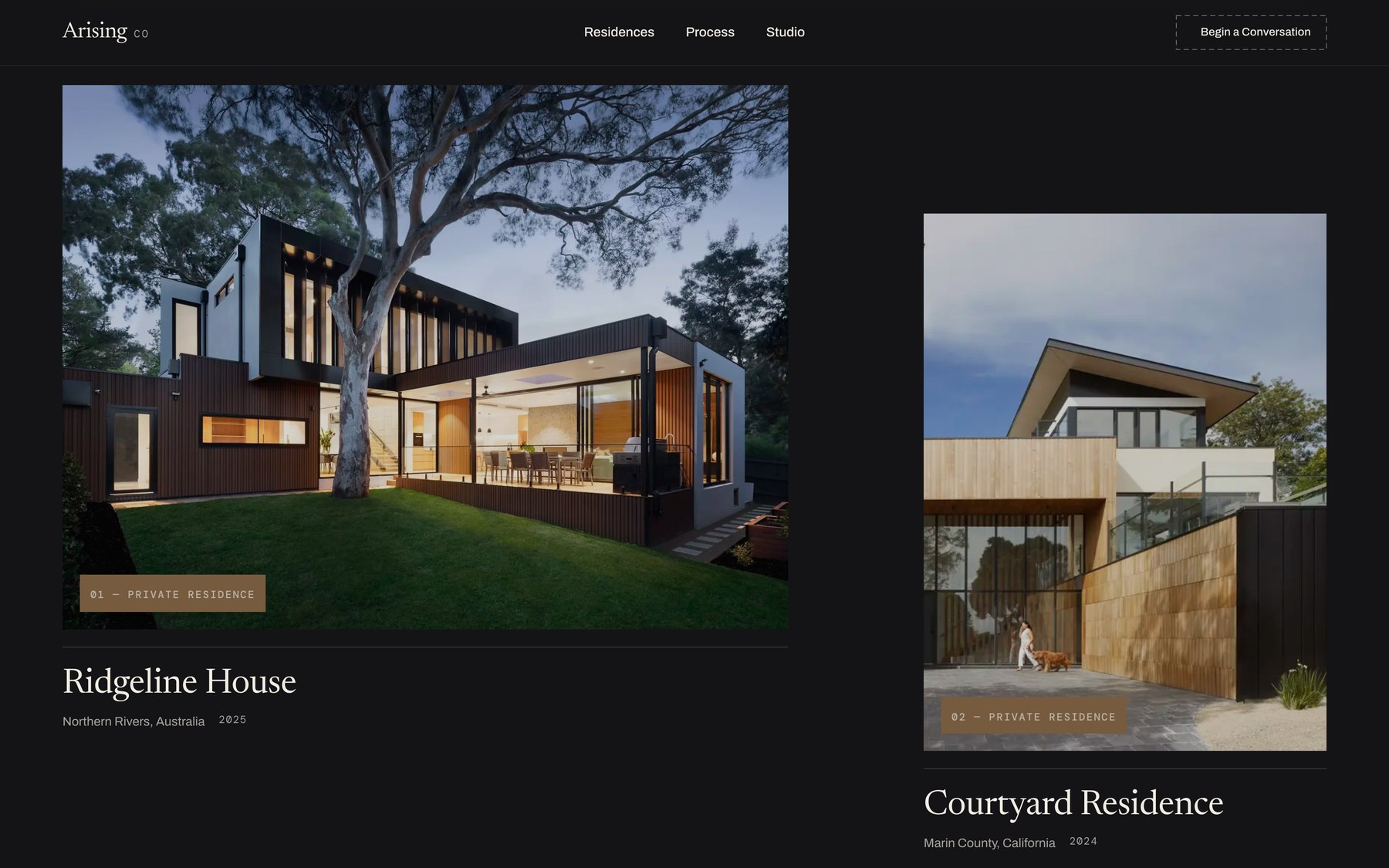


Blueprint Arising is a concept build. We made it ourselves to show what is possible for a design practice, not on commission. The transition it animates — drawing to building — is the thing an architecture practice actually sells, rendered literally.
What We Build for a Practice
Weighted toward publishing the reasoning behind the work, because that reasoning is the product and almost no firm puts it anywhere a client can read it.
Fee Transparency, Done Carefully
How residential design fees are structured, what percentage-of-construction actually means, what a feasibility study runs, and when hourly makes sense. Ranges and reasoning rather than a rate card, because the alternative is the client inventing a number and never calling.
Projects Documented as Arguments
Each project as a page that carries the brief, the site constraints, the governing idea, and the decisions that followed. Not a slideshow. The reasoning is the product a practice sells, and almost no firm publishes it where a prospective client can read it.
Residential Search by City and Style
Residential architect searches are geographically tight and stylistically specific. We build the city, neighbourhood, and typology pages that catch them, which in most markets are being contested by almost nobody.
Credential & Licensure Signals
Registration, AIA membership, awards, and published work handled so they read as evidence rather than a wall of logos. A homeowner cannot evaluate design quality, so they evaluate the proxies — and those proxies need to be legible and verifiable.
Local Visibility Without the Cheapening
Map presence and location pages worked properly, so the practice appears where local searches resolve without inheriting the discount-contractor positioning that usually comes attached to that channel.
Attribution Across a Long Cycle
Which searches and pages produced the consultations that became commissions. At five to fifteen significant projects a year, lead counts are meaningless — the only number worth reporting is signed work and where it came from.
Practices We Work With
Small and mid-size licensed practices doing residential and mixed residential work, where the principal is still involved in every project and the marketing has never been anyone's actual job.
If you run design and construction under one contract, the design-build page fits better. If your practice is site and landscape rather than buildings, see landscape architect marketing.
- Residential architecture practices
- Custom home and estate architects
- Architecture and interiors studios
- Small and mid-size licensed firms
- Practices expanding into a new market
- Firms diversifying off referral income
Related Pages
The two questions practices usually arrive with, and the firms they share a client with.
How the Channels Fit Together
A rebuilt site creates the project pages and fee explanations that architect SEO then ranks, and the same depth is what gets a practice cited by AI search when a homeowner asks an assistant how to find an architect. Because commission volume is low and value is high, paid search is usually a narrow, deliberate supplement here rather than a primary channel.
Practices routinely share a client with the builder who constructs the house and the interior designer who furnishes it, which is why those pages exist alongside this one.
Our process is written out step by step, and our case studies are published with the numbers attached.
Architecture Firm Marketing, Answered
Should an architecture practice market itself at all?
The objection is usually about dignity — that a serious practice is chosen on the work, not on advertising. Fair enough, and nothing here suggests otherwise. What we are describing is publishing your thinking where the people who need it can find it: how you approach a site, what a project actually costs, what the design process involves, and why particular decisions were made on the houses you have already built. That is not advertising. It is the same thing an architect does in a lecture or a monograph, placed where a homeowner planning a house in your city will actually encounter it. The practices that have done it are typically the only ones visible in their market, because most of the profession shares the same instinct.
How much should we say about fees publicly?
Enough that a homeowner can work out whether they can afford you, and no more. In practice that means explaining how fees are structured — percentage of construction cost, fixed fee by phase, hourly for early feasibility — with honest ranges and the factors that move them. It does not mean a rate card. The reason to do this is specific: a homeowner with no reference point assumes a number, and the number they assume is almost always high enough to stop them calling. You never hear from the ones who ruled you out. Publishing a range converts some of those silent exits into conversations, and filters the rest before either side spends time.
Our work comes from builders and developers, not homeowners. Does this apply?
It applies differently and it still applies. Builders and developers research architects the same way everyone else does, usually before making an introduction and always after receiving a name. A practice whose work is documented properly online is easier for a builder to recommend, because the recommendation is doing less work — they can send a link instead of vouching from memory. There is also a direct channel most firms ignore entirely: developers searching for architects with experience in a specific typology or jurisdiction. Those searches have low volume and extremely high value, and they are usually uncontested.
What results should a practice expect, and when?
Expect the first meaningful search visibility in three to six months and a steadier flow of qualified inquiries between six and twelve. The more important shift usually arrives earlier and is harder to measure: the conversations get better. When someone arrives having already read how you work, what you charge, and the reasoning behind three of your projects, the first meeting starts from a different place and the fee conversation is considerably less adversarial. For a practice signing five to fifteen projects a year, moving two of those from price-shopping to pre-sold is worth more than any increase in inquiry volume.
Free SEO & AI Search Audit
Find out who owns the architect searches in your city.
In most markets it is two firms and a directory. We will show you exactly who, on which searches, and what it would take to be there instead.
Find out if AI and Google recommend your company.