
Marketing for Design-Build Firms
Your model is the strongest argument in residential construction and almost nobody has heard it. We build the content that explains design-build, answers the conflict-of-interest objection head-on, and reaches a homeowner before they assume their first call has to be to an architect.
Free SEO & AI Search Audit
Find out if AI and Google recommend your company.
A strategist checks Google, Maps and AI assistants and sends your audit within 2–3 business days.
- Where you show up in Google and AI search
- Who gets named instead of you
- A prioritized plan, not a sales pitch
Why the Best Argument in the Category Never Gets Made
Design-build firms tend to have the clearest value proposition in residential construction and the vaguest marketing, because the site was built for a builder and the argument needs a different page entirely.
Two other firms have already called it a conflict of interest.
Every architect and every general contractor competing against you has a version of the same line: that combining design and construction removes the check on cost. It is the most common objection in the category and almost no design-build firm answers it publicly — which leaves it standing as the last thing the homeowner heard.
Homeowners do not know the model exists.
Most people planning a significant project assume the sequence is architect first, then bids, then builder, because that is the only process anyone has ever described to them. They are not rejecting design-build. They have never encountered it, so they never search for it and never ask whether there is another way.
You market as a builder and compete as one.
Most design-build sites are builder sites with a design page bolted on. That framing puts you straight back into a construction bid comparison, where the single genuine advantage you have — one contract, one accountable party, cost and design resolved together — never enters the conversation.
The Work
Showing Both Halves of the Work
Blueprint Arising is a concept we built around exactly this idea: a scroll-driven sequence that starts as a wireframe drawing and resolves into the finished building. For a firm that both designs and builds, that transition is the entire pitch.
Blueprint Arising
Concept build

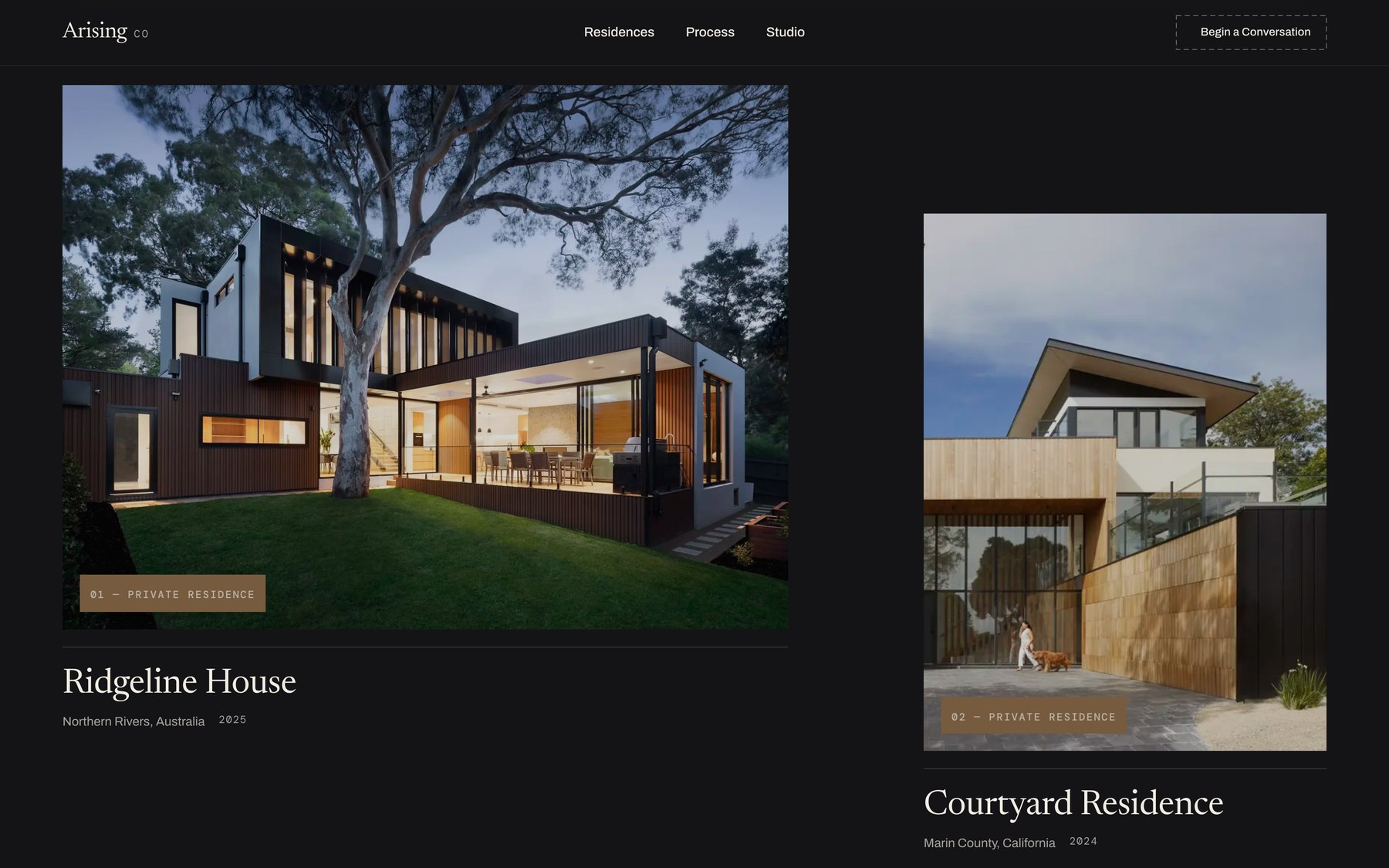


Blueprint Arising is a concept build rather than a client commission — a working site we made ourselves to demonstrate the approach for design-led builders and practices.
What We Build for a Design-Build Firm
Weighted toward explanation and objection handling, because the model is the product and most of the market has not had it described to them.
The Model, Explained Properly
What design-build actually is, how the phases run, who holds what responsibility, and where it differs from design-bid-build. The foundational content, and the reason most homeowners never consider the model is that nobody has written this for them.
The Objection, Answered Head-On
A page addressing the conflict-of-interest argument directly, including where it has genuine merit and what your contract structure does about it. Answering the strongest version of the criticism is considerably more persuasive than avoiding it.
Single-Contract Cost Content
How pricing works when design and construction sit under one agreement, what open-book means in practice, and how change orders are handled. Cost certainty is the real selling point of the model and it needs a page, not a paragraph.
The Timeline Advantage, Quantified
Design-build overlaps phases that design-bid-build runs in sequence, and on a large residential project that is often months. Shown as a real schedule comparison rather than asserted as a benefit.
Projects Documented Through Both Phases
Each project carried from early concept through construction to the finished result — the one thing a design-only or build-only firm structurally cannot show, and the most convincing demonstration the model works.
Attribution Across a Long Cycle
Which searches and pages produced consultations that became signed agreements, tracked across a cycle long enough that most analytics setups lose the thread entirely.
Case Study: Springhetti Group
A design-build firm, with the numbers.
Springhetti Group designs and builds luxury outdoor spaces across northeast Wisconsin under a single contract — pools, outdoor kitchens, pergolas, and the hardscape tying them together.
We rebuilt the site around the work itself and ran search, paid, and conversion as one program. Engagement rate rose 107.54% year over year, organic became close to half of all traffic, and the calendar is booked into 2027.
Engagement rate after the rebuild
Of traffic now from organic search
Return across the engagement
Project value won entering a new market
Firms We Work With
Residential firms carrying design and construction under one agreement, whether that grew out of a building company adding a design studio or a practice deciding to build what it draws.
If construction is the whole business, see custom home builder marketing. If design is, marketing for architects is the closer fit. For design-build in the backyard rather than the house, see outdoor living.
- Residential design-build firms
- Builders with in-house design studios
- Architecture practices that also build
- Design-build remodeling firms
- Outdoor living design-build companies
- Firms moving from build-only to design-build
Related Pages
Where the Channels Fit
Most of the work here is content and search, because the job is introducing a model to people who have not encountered it — and that happens in the questions they ask before they know what to search for. A rebuilt site is usually required first, since projects have to be documented through both phases and a builder template has nowhere to put the design half.
The same explanatory depth is what earns citations in AI search, which is increasingly where a homeowner first asks whether they need an architect at all — the exact moment a design-build firm wants to be in the answer.
Our process is written out step by step, and our case studies are published with their numbers.
Design-Build Marketing, Answered
How should a design-build firm position against architects and general contractors?
On accountability and cost certainty, not on price or speed. The structural argument for design-build is that one party is responsible for both what gets drawn and what it costs to build, which removes the gap where design-bid-build projects usually go wrong — a set of drawings priced well above what the client can spend, followed by months of value engineering. That is a genuinely strong position and it needs to be made explicitly, with the process explained and the contract structure described. What does not work is competing as a builder who also draws, because that framing drops you back into a bid comparison where your actual advantage is invisible.
How do we answer the conflict-of-interest objection?
Publish a page about it and steelman the argument before answering it. The objection is that when the designer and the builder are the same company, nobody independently checks whether the construction price is fair, and that is a real risk rather than a smear — there are design-build firms where it plays out exactly that way. What separates you from them is structural: open-book pricing, an independent estimate at schematic, a fixed design fee that is not contingent on construction value, or a right to bid the work out. Say which of those you do. Firms that address the strongest version of the criticism in public convert better than firms that hope the prospect never hears it, because the prospect always hears it.
Should we market the design side or the construction side?
Both, on separate pages, then the integration on a third. In practice they reach different people at different moments. The design content reaches a homeowner at the beginning, when they think their first call has to be to an architect — and that is the most valuable moment to be present, because whoever is there frames the entire process. The construction content reaches people further along who already have drawings and are looking for someone to build. The integration page is what converts both groups, because it is where the single-contract argument gets made. Firms that publish only the construction side are invisible during the phase that decides everything.
Does search actually reach people who are looking for design-build?
Partly, and the shortfall is the opportunity. The term itself has real but modest search volume because most homeowners have never heard it, so building only for "design-build [city]" reaches a small audience. The larger opportunity is in the questions people ask before they know the model exists: whether they need an architect, how the process works, what it costs to hire an architect and a builder separately, and why projects come in over budget after drawings are complete. A design-build firm answering those questions introduces the model to someone who would otherwise have defaulted to the sequence they assumed was the only one.
Free SEO & AI Search Audit
Find out who is answering the questions your buyers ask first.
We will show you which pre-decision searches happen in your market, who currently owns them, and where a design-build firm can realistically get in front of the default.
Find out if AI and Google recommend your company.