
Website Design for Luxury Home Builders
You build homes worth several million dollars and show them in a gallery plugin at 400 pixels wide. We build the site that presents the work the way the work deserves — and makes the argument for your price while it does it.

What Is Wrong With Most Builder Websites
None of this is a design opinion. Each one is a specific place where a family who was ready to spend real money decided you were interchangeable with the next firm on their list.
Your photographer did their job. The template undid it.
You paid a professional to shoot a seven-figure home properly, and the theme renders it at 400 pixels wide inside a gallery plugin that opens a lightbox. The single most expensive marketing asset the firm owns is being displayed at the resolution of a thumbnail, next to a stock photo of a hard hat.
Thirty homes, one page.
Most builder sites have a Portfolio page where every project gets a paragraph and six images. That is one page competing for every search, one page carrying every story, and no way for a visitor to go deep on the one home that looks like theirs — which is the only home they came to look at.
Nothing on the site says why you cost what you cost.
A buyer comparing three builders is looking for a reason to pay more. If the site is images and a contact form, there is no argument on the page, so the only remaining basis for comparison is price. That is a fight the best builder in a market loses roughly as often as the cheapest one wins it.
The Work
A Builder Site, Section by Section
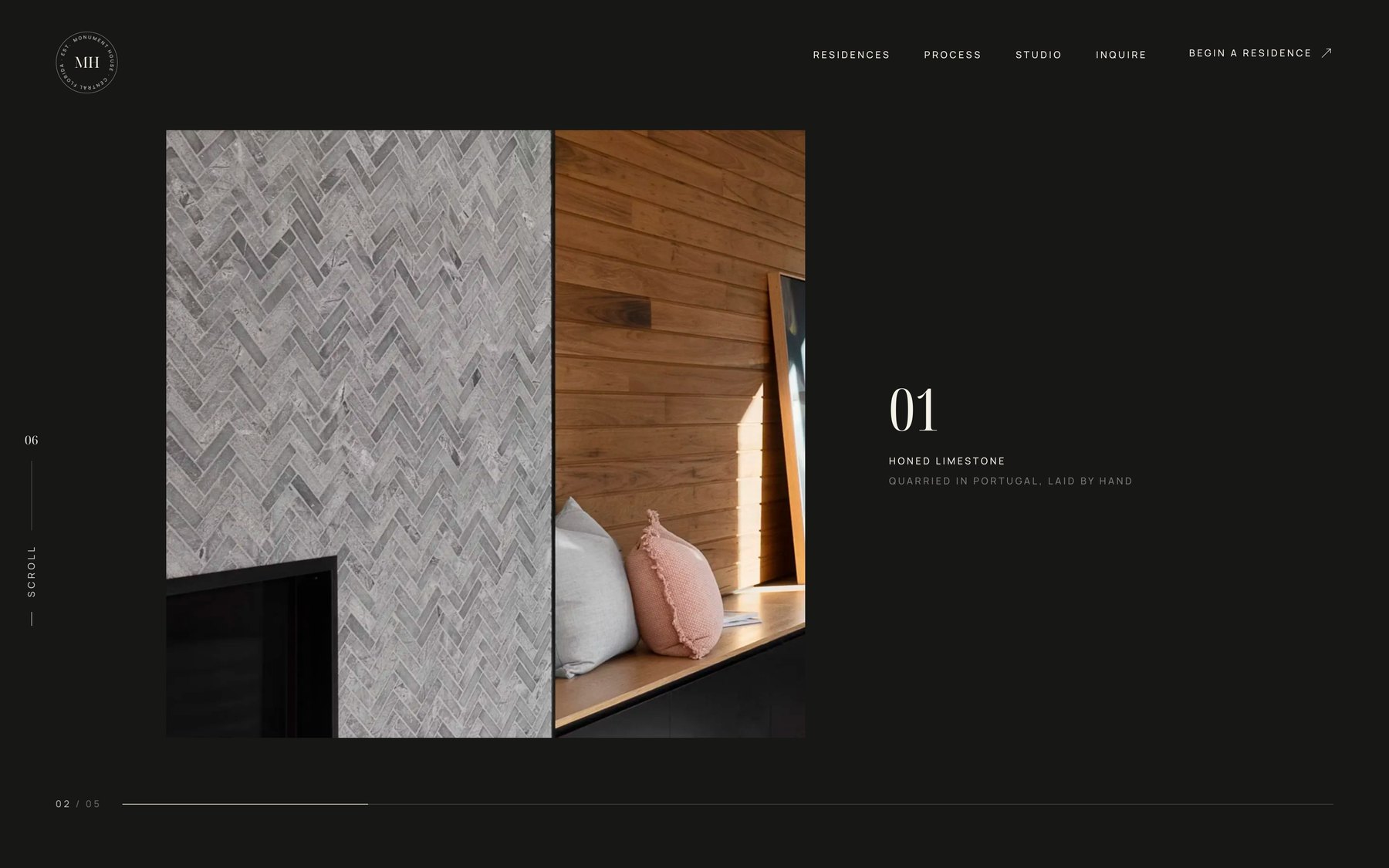
Monument House is a concept we built to demonstrate this exact argument — a complete working site rather than a mockup. Below it, the live Springhetti Group rebuild, where the same principles were applied to a real client and produced measurable results.
Monument House
Concept build



Springhetti Group
Client engagement

Monument House is a concept build, not a client engagement — we made it ourselves to show what is possible. Springhetti Group is a live client rebuild, and the numbers attached to it are theirs.
What Goes Into the Build
Six things that separate a builder site from a contractor template, in rough order of how much difference each one makes.
Photography at Full Bleed
Homes shown at the size they were shot, properly compressed and responsively served so a full-screen photograph does not cost four seconds of load time. The work gets the whole screen instead of a corner of it.
Every Home Its Own Page
Location, year, square footage, and program up front, then the house the way a monograph would move through it: the governing idea, the material decisions, the details that cost money. Thirty homes becomes thirty pages rather than one.
A Positioning Section Before the Portfolio
Stated commitments placed before the first project, because a grid of beautiful houses looks much the same from firm to firm. A philosophy is considerably harder to shop against than a photograph.
Process & Timeline, Written Out
Land through closeout with real durations attached. It filters out the prospects who wanted something you were never going to do, and it does that before they occupy three meetings finding out.
Built for a Phone in a Kitchen
Most of the browsing happens on a phone, at night, with a spouse. Full-bleed photography, horizontal galleries, and long project pages all have to work at 390 pixels wide or they do not work at all.
Fast Enough to Survive the Imagery
Image-heavy sites are usually slow sites, and slow sites lose the visitor before the first photograph resolves. Modern formats, proper lazy loading, and a build that stays quick with sixty full-width images on the page.
Who This Build Is For
Firms with a genuine body of finished work and photography to match, currently displayed by a template that flattens both. If your photography is the problem rather than the site, say so early — we would rather tell you to spend the budget on a photographer than build a beautiful frame around images that cannot carry it.
Adjacent builds we do for the same buyer: architecture firm websites, interior designer websites, and outdoor living websites.
- Custom and luxury home builders
- Estate and second-home builders
- Builders with in-house design studios
- Semi-custom and spec builders
- Builders with strong photography, weak sites
- Firms rebranding or repositioning upmarket
Related Pages
A Rebuild Is Also an SEO Project
Turning thirty homes into thirty pages is a design decision and a search decision at the same time. It is the single largest expansion of rankable surface area available to a builder, which is why we run web design and builder SEO as one program rather than two invoices. The same depth is what gets a firm cited in AI search results, which increasingly answer by synthesizing whoever explained something clearly.
If you want to see how an engagement runs before committing to one, our process is written out step by step, and every case study we publish includes the numbers.
Builder Website Design, Answered
What makes a luxury home builder website different from a normal contractor site?
Three things, and they all follow from the price point. First, the photography has to be the interface rather than an accent — a full-bleed image is doing the work a paragraph of copy does on a plumbing site. Second, each completed home needs its own page with real narrative depth, because a buyer comparing builders wants to understand the reasoning behind a house, not just look at it. Third, the site has to make an argument about why the firm costs what it costs, which means process, philosophy, and materials get actual sections rather than a line in the footer. A contractor site optimises for the fastest possible path to a phone call. A builder site optimises for a forty-minute browse that ends in a serious inquiry.
We have great Instagram. Do we need the website to do this too?
Instagram is excellent at the thing it does, which is keeping you visible to people who already know you. It is close to useless at three things a builder needs: it does not rank in search, it gives a prospect no way to go deep on the one home that resembles theirs, and it cannot carry the process, cost, and materials explanation that justifies your price. There is also the ownership question. Every follower you have is rented, and the terms change without notice. The site is the asset you keep. In practice the two work best together — the feed keeps you present, the site does the convincing.
How long does a builder website take to build?
A properly built builder site with ten to fifteen documented project pages typically runs eight to twelve weeks, and the variable is almost never development. It is content: getting the photography organised, confirming the specification details for each home, and writing the narrative for the projects. Builders who already have their photography sorted and can give us a decision-maker for an hour a week land at the short end. The ones who need us to chase image files across three phones and a Dropbox land at the long end. We do this in stages so the site goes live with your strongest eight to ten homes rather than waiting on the full library.
Will a rebuild hurt our existing rankings?
Not if it is handled properly, and it usually improves them. The risk in any rebuild is losing the URL history — pages that ranked get new addresses and the equity is dropped. We map every existing URL to its new destination, redirect them permanently, keep the pages that were earning traffic, and expand rather than replace the content that was working. The gain is that a site with thirty project pages, a real cost section, and a process explanation simply has far more surface area to rank with than a five-page brochure did. If search visibility is the primary goal rather than a side effect, that is what the separate page on builder SEO covers.
Website Review
Find out what your current site is costing you.
We will go through your site the way a prospect does, show you where the drop-offs are, and tell you plainly whether a rebuild is worth it.
Find out if AI and Google recommend your company.