
Marketing for Interior Design Studios
You do not have a visibility problem. You have a qualification problem — plenty of interest, most of it from people who do not know what full-service design costs. We build the site and the search presence that reach the client who does.
Free SEO & AI Search Audit
Find out if AI and Google recommend your company.
A strategist checks Google, Maps and AI assistants and sends your audit within 2–3 business days.
- Where you show up in Google and AI search
- Who gets named instead of you
- A prioritized plan, not a sales pitch
Why Good Studios Get the Wrong Inquiries
Almost every studio we talk to describes the same week: eleven inquiries, nine of which wanted something you do not sell at a price you could not do it for. That is not a marketing volume problem. It is a definition problem.
Instagram brings you the wrong client.
A feed optimised for saves attracts people who love the images and have no budget. Nothing about a grid post communicates that full-service design is a five- or six-figure engagement, so the inquiries arrive expecting an hourly consult and a shopping list. The platform is excellent at reach and structurally incapable of qualifying anyone.
Nobody understands what they are buying.
Homeowners genuinely do not know the difference between full-service design, e-design, a consultation, and decorating — or how designers charge. Flat fee, hourly, cost-plus, percentage of project. Confusion at this stage does not produce questions. It produces silence and a Pinterest board.
Your best work is invisible to search.
Thirty projects, professionally photographed, sitting inside a gallery plugin with one URL, no written descriptions, and filenames straight off the camera. To a visitor it is an impressive portfolio. To a search engine it is a nearly empty page — and to an AI assistant answering a design question, it does not exist.
The Work
What a Design Studio's Site Can Do
Monument House is a concept we built for the luxury residential trades. The sections below that matter most to a design studio are the project interiors and the materiality treatment — where finishes get shown at close range and a specification stops being a line item.
Monument House
Concept build

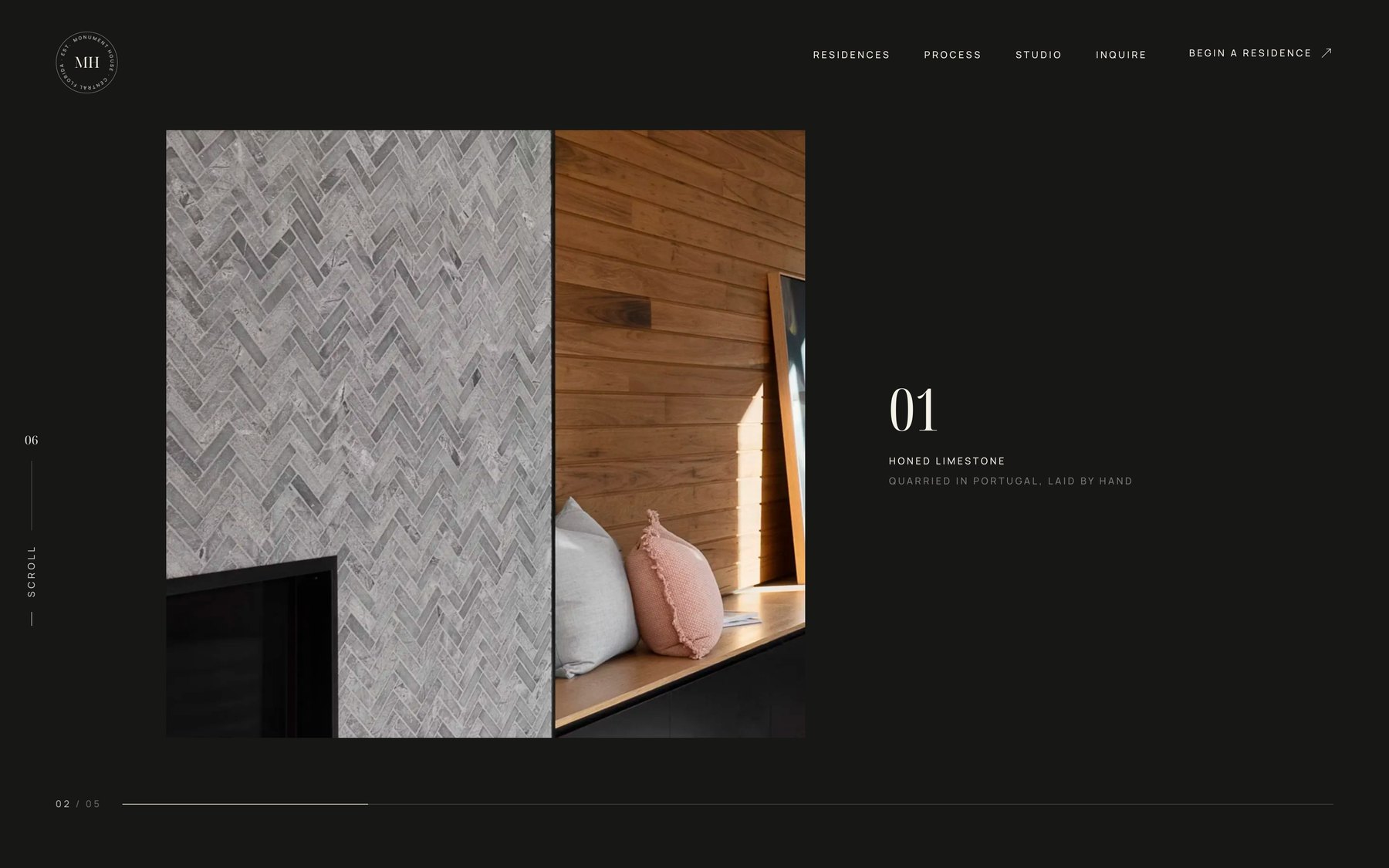

Monument House is a concept build, not a client project — a complete working site we made to demonstrate the approach for builders, architects, and design studios.
What We Build for a Studio
Weighted toward definition rather than reach, because reach is the thing a design studio already has and qualification is the thing it does not.
Service Definition, Written Plainly
Full-service, e-design, consultation, and staging explained as distinct offers with what each includes and roughly what it costs. Most of the wrong-fit inquiries a studio receives are caused by this page not existing.
Fee Structure, Explained
Flat fee versus hourly versus cost-plus versus percentage, what a full-service project runs at different scopes, and what the furnishings budget has to be for the engagement to make sense. The single most effective qualification tool available to a studio.
Projects as Indexable Pages
Each project with its own URL, written narrative, room-level detail, style, town, and properly described images. It converts a portfolio from something a visitor admires into something search and AI assistants can actually read.
A Site Instagram Cannot Replace
The feed keeps you visible to people who already follow you. The site does the work the feed cannot: ranking in search, letting a prospect go deep on the one project like theirs, and carrying the process and pricing that turns interest into an inquiry.
Local Visibility for Design Searches
Interior designer searches are intensely local and map-driven. Profile, reviews, and location pages worked properly, so the studio appears for the searches where a client with a real project is looking for someone nearby.
Tracking to Booked Projects
Which searches, projects, and pages produced consultations that became signed engagements — not inquiry volume. A studio taking eight to twelve projects a year is optimising for fit, and inquiry counts actively mislead.
Studios We Work With
Residential studios selling full-service design, and the kitchen, bath, and new-construction specialists working alongside builders. If the studio is capacity-constrained rather than lead-constrained, this work is about fit and fee rather than volume — and it tends to pay off faster.
Designers regularly share a client with the builder and the architect on the same house, which is why those pages sit beside this one.
- Full-service residential design studios
- Kitchen and bath designers
- New construction and model home designers
- Designers working with custom builders
- Commercial and hospitality designers
- Studios moving upmarket from e-design
Related Pages
Site, Search, and the Feed
A rebuilt site creates the project pages and fee content that interior designer SEO ranks, and local SEO works the map layer where most design searches resolve. The written depth is also what earns a studio citations in AI search, which increasingly answers style and cost questions directly.
None of this replaces the feed. Keep it — it does something the site cannot, which is stay present between projects. The site does the two things it cannot: rank, and explain what an engagement actually costs.
Our process is written out in full, and our case studies carry their numbers.
Interior Designer Marketing, Answered
Why market at all when referrals and Instagram already bring work?
Because neither can be aimed. Referrals arrive when they arrive and cannot be increased in a quiet quarter. Instagram brings volume and almost no qualification — it is very good at reaching people who love your images and says nothing about what working with you costs, which is why so many studio inquiries come from people expecting a two-hour consultation. What a properly built site adds is selection: it reaches the client actively searching for a designer in your city with a project already underway, and it tells them what full-service involves before they make contact. Referrals also look you up, every time, and what they find either confirms the recommendation or quietly weakens it.
Should we publish our fees?
Publish your structure and a minimum, at least. The fear is that numbers scare people off, and they do — they scare off the people who were never going to hire you, which is the entire point. The client who can afford full-service design is not deterred by a minimum project size; they are relieved to have found it, because their actual worry is wasting three weeks on a studio that turns out to be wrong on price. Studios that publish a structure and a starting point consistently report fewer inquiries and considerably better ones. If a full rate card feels like too much, explain how you charge and state a minimum furnishings budget.
How does image SEO work for a design studio?
Your photography is a rankable asset, but only once it is structured for it: descriptive filenames instead of camera defaults, alt text that says what the room is and where, modern fast-loading formats, and project pages that give each shoot real context — location, scope, style, and rooms. Done properly, your work appears in Google Images and in AI search answers for the styles and room types clients search, which is a discovery channel most studios leave entirely unclaimed. The prerequisite is structural: images inside a gallery plugin with one shared URL cannot carry any of this, no matter how well they are named.
Is this worth it for a small studio?
Design engagements are high-ticket enough that the arithmetic works at small volumes — a single full-service project often runs well into five or six figures, so two additional well-fitted projects a year changes the business meaningfully. Small studios also have a real structural advantage in local search, where proximity, reviews, and genuine local work matter more than size, and a focused studio with a strong portfolio can beat national platforms and franchises on exactly the searches that produce local projects. The thing to be realistic about is capacity: if you can only take ten projects a year, the goal is better-fitted inquiries, not more of them.
Free SEO & AI Search Audit
Stop getting inquiries you have to turn down.
We will show you where your portfolio is invisible to search, which searches are bringing you the wrong client, and what it would take to be found by the right one.
Find out if AI and Google recommend your company.