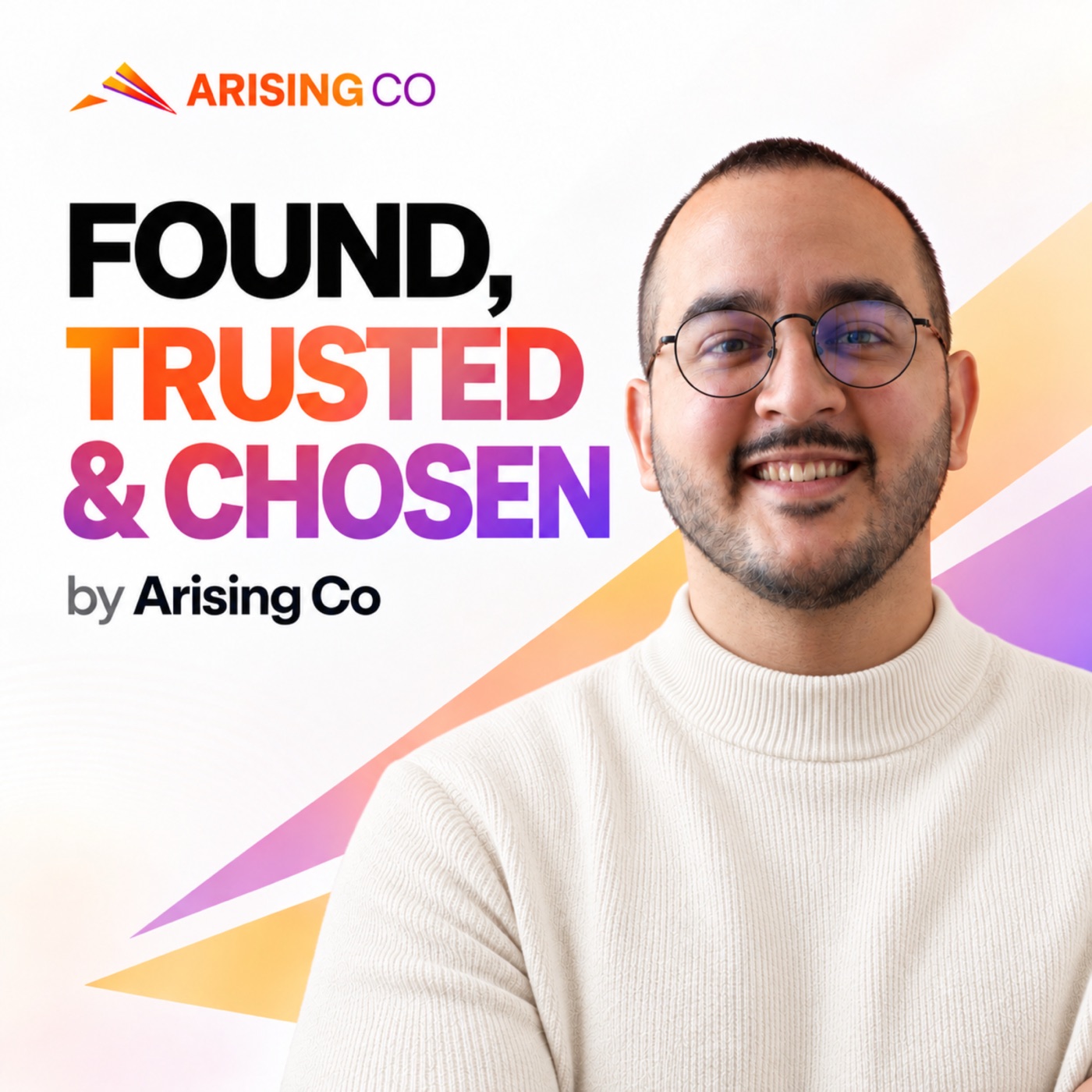
Hello everyone, Michael Santiago here. Welcome to Episode 2 of the Found, Trusted and Chosen podcast by Arising Co.
Today we're going to dive into something that is both fun and, I think, will be of incredible value to you. I say fun because it's a conversation that we have many times with our clients.
Today's discussion is really going to be focused on what you do as a business, or as a solopreneur, when word of mouth and referrals start to dry up.
Now, you may have a business that for the last 10 or 15 years, even 5 years, has been running off word of mouth and running off referrals. And I know many people, many friends, that have that, and it's working for them, right?
And so oftentimes what I find is that these peers of mine, their websites are not up to date. They're not necessarily modernized. They're not necessarily aiming to gain an advantage through search engine optimization, being found on AI and all that stuff, because predominantly their business comes from referrals and word of mouth.
And because it's been such a long tenure in which they've acquired that, it makes complete sense for them to not modernize. And I totally get that.
However, things are changing. The climate is changing. And maybe you've been in that boat where referrals and word of mouth have done really well for your business. I know it's done well for us.
But recently I was talking with a mentor and friend who owns a multimillion-dollar marketing agency, and he was telling me, "Hey, Michael, you need to establish farms."
When you're a farmer, you purchase seed, or you have seeds, and you sow those seeds, and the farmer knows that there is going to be a harvest eventually, Lord willing. Hopefully there isn't anything that ruins the crops, and all that good stuff. But there's this expectation of a harvest.
And so you can look at SEO and modernizing your website as a farm. If you're already getting referrals and word of mouth, you can say, "Hey, that's a farm. That farm is enabling our business to thrive." But what about the farm of your website?
When it comes to search engine optimization, is your website being found on Google? Or now AEO and GEO: answer engine optimization and generative engine optimization.
Here's what the two mean. When you go on Google and you look up a question, Google now normally pops up with Gemini, and Gemini gives you a response. That would be the answer engine. It's giving you an answer and pulling in information from a variety of websites, which you can then either pursue for more knowledge, or just be satisfied with the answer that Google gives you. You never even have to click on those websites.
Now, generative engine optimization is when you're using ChatGPT, Claude, Gemini or Perplexity, and you're asking them specific questions like, "Who is a custom home builder here that has at least 10 years of experience and whose pricing maximum is $1.5 million, because that's our budget?"
You can have such a long, contextualized question. And now the generative engine, ChatGPT, Claude, whichever one you use, its job is to send out little mini agents, mini spies, to go out and scour the land of websites and see if those websites have the necessary context and information to come back with an answer.
So what does this mean? If you gave that query, the website the AI is trying to find has to include somewhere a minimum price and a maximum price, just in order to qualify for that question, because that question specifically gave a budget.
And why is this important? Because when you're seeking to establish a farm on SEO and AEO, being found on Google and being found on AI, your website matters way more than you may think. Especially if you're coming from the realm where you've predominantly relied on referrals and word of mouth.
You may still be doing that, but there may come a time when those referrals and word of mouth begin to dry out. And as they dry out, are you still going to be at the volume you need to keep proper cash flow for your business?
That's what my mentor was alluding to: build out these farms. That way your farm is working for you, and you're always getting people who not only can see your reputation, but can also engage with your business and actually do business with you.
So that's the focus of today's episode. It's me asking you questions to help you think: One, do I need to modernize my website? Two, do I even know my metrics? Do I even know who's actually visiting my website? And do we have proper attribution in place, so that we know all the analytics, all the data, all the conversion tracking, to see where this customer came to our business from, and then prioritize that particular farm?
So the first point that I want to make is that your reputation can only take you so far.
If you're mainly getting referrals and word of mouth, and I'm speaking to that camp, your reputation is probably doing well, especially if many people are giving you referrals. It means that you're doing a great job and doing great work. Keep that up.
However, what happens with someone who doesn't know you, and doesn't know the friends and business partners who are referring people to you? Let's say you're not even at capacity. You can still get more.
Let's say you're up against a competitor, and someone is trying to find you, looking for your services. But they don't find you, because your website isn't modernized, or because you don't have a proper SEO and AEO foundation.
Or maybe you hired a team that's supposed to be doing that, but they're not really doing it, and you're not following up with them because they're just giving you reports of clicks and this and that, and you're satisfied, but you're not doing your due diligence to actually check it out.
You should be very diligent in asking those questions. Many of the clients we've served had been served by SEO companies before, and many of them got burned, because there's such a massive number of people out there who claim to know this stuff and do this stuff, but they really don't know what they're doing. And you're probably paying them thousands of dollars every single month because you can afford to, but all of that is going down the drain.
So what happens is your competitor ends up getting found and you don't, because your competitor is actively optimizing their website presence, optimizing their search engine presence, optimizing their AI search presence. They're getting reviews, they're building up their citations. And you may be doing some of that, but because you're not really focused on that farm in particular, you're not going to get anywhere.
That's what I mean by your reputation can only take you so far. Yes, you can be satisfied with the clientele you get through your referrals and your systems, and if that keeps going, awesome. But if you're not even at capacity, why wouldn't you want to get more clients and serve more clients? Especially if you end up serving them better than your competitors do.
That's one of the things I had to deal with personally. I had to say, man, I've been content with X amount of clients. But the more conversations I have in discovery calls with prospects, and with people who eventually do become clients, the more I realize that many of them have been serviced wrongly.
That has stirred me up to really pursue more effort on the inbound and the outbound, so that we can prevent people from experiencing that very thing. Because when we work for you, we make sure that everything is aligned and that you have full transparency.
This is not me trying to do a shameless plug here, but those are the kinds of things SEO agencies and marketing agencies need to be accountable for. We need to show you the strategy we're running. Where are the analytics? Where is the data? Does the data actually support the findings? Does it actually support the fact that you're getting more revenue? And if you're not getting more revenue, but the data says something different, then what's the disconnect?
Now, the next point is that your website needs to reflect what you've become, and not what your company was many years ago.
I see it many times. Websites just have their copyright footers updated year after year, but the content and a lot of the other things don't really change, especially in the last five years. But those are the very things that need to change.
One of the errors I see constantly is people using images to display information. But AI agents and search crawlers can't read the text on your image when they crawl through your website. They need actual text. That's one of the simplest mistakes people end up making.
Another thing is that your competitors may be actively continuing, year after year, to upgrade, to add more of their case studies, to add more to their gallery, to add more information.
But a lot of times what I'm finding is that there's a huge sea of custom home builders and outdoor living companies that are pretty much the same. They all look alike. Their websites are all very templated. And some of them have far less information than others. So the ones with more information end up getting picked up and recommended more by AI.
Those are the kinds of things you want to ask yourself about: Is my website properly reflecting who we've become as a business? Is my story told well enough?
Today, being September 30th, Kinsta released a report on how AI traffic has engaged with 5,000 WordPress websites. AI is obviously recommending websites and companies and businesses to the people asking the questions, on ChatGPT for example.
But now the issue is: when people land on your website, are they going to trust you? Does your website look like it's up to the caliber of the reputation you currently possess? And if it doesn't, you have a complete disconnect between your brand reputation and your website's presentation of that reputation.
So what ends up happening? Let's go back to that question about a luxury custom home builder and my $1.5 million budget. Say I ask ChatGPT, and it comes back with five companies near my area. I check each of those websites, and I find that one or two of them are far above the cut. Their website presentation, the experience, looks like the reputation they've come to build. You best believe I'm going to ignore the other three and base my decision on those two.
And what does that mean? It means your website is so much more important now that AI is making the decisions, going out there and finding an answer to the user's request.
So if I'm looking for the best pool service guy here in Orlando or Winter Park, it's going to make recommendations. There are a lot of people already building up their reviews and building up those citations. But when I look at your website experience, that's going to be one of the differentiators in whether I choose your company or someone else.
This is why I can't stress enough the whole point of this podcast, the title: being found, being trusted, and being chosen. You can be found with the SEO and ChatGPT layer. AI is now finding these websites and your business. But are you trusted? Does your website represent a modern experience that actually reflects your reputation? And if it doesn't, you've got to get to work. You've got to get on that.
We'd be glad to help. Reach out at thearising.co. Send me a message, find me on LinkedIn, on whatever channel you're listening to this from. Just reach out. Our business line is 321-401-7016.
This is a shameless plug. Why? Because we want to see you succeed and actually get a modernized website that reflects your reputation, especially nowadays when people are getting their recommendations through AI.
And not to beat a dead horse, and I think I've shared this already across our social media platforms, but someone found us on Claude, someone else found us on ChatGPT, and someone else found us through Google and Google Gemini.
And what did they do? They immediately checked our website to see whether it reflected the reputation we've come to build. If our website looked very poor, I guarantee you they would not be calling us and engaging with us, because there is still the job of choosing the actual company you want to work with.
And if it doesn't look reputable, if it doesn't look trusted despite the many reviews it has, then you've got a problem that needs to be resolved.
That's why I can't emphasize enough the day and age we live in now, especially with the Kinsta report that came out. I'll drop that link in the description. It's so vital now to make sure your website represents your story and your business properly.
Your about page, for example. You should have photos of your team members, maybe even some images of your team at work. Something that is not stock.
Because there are so many stock images out there, and so much AI slop, that it's subconsciously getting into people's minds: "Man, I don't know that I want to work with this company. Those aren't actual real images."
Or maybe you used AI to doctor some images. People are not dumb. They're catching on to that.
They're catching on to the reality of, "Hey, I'm on your website, and it looks like you're teaching a ballroom full of leaders. But when I look closer, the image is made with AI. It doesn't even fully look like you. It looks like a younger version of you."
And yes, I know that's what you do. But now that I see this AI image, the questions that come to my head are: Have you really done this? What's your experience level? Who are the people who have actually benefited from it, and what kind of people are they? Do they fit my ICP? Do they fit my audience?
And if they don't fit my persona, then I want nothing to do with you, because I've already lost trust in you just from seeing stock images or AI-doctored images that don't properly reflect your business. That's key.
The third point behind this episode is more of a beckoning call for you. It's to find out whether Google or AI is actually recommending you.
There are free tools that Google provides, like Google Search Console. Bing has Bing Webmaster Tools. People seldom use Bing, but it still has a small percentage of search queries, so it's still useful to have.
What these two tools do is show you, monthly, how people are finding your website. What are the search queries people type into search engines that actually bring up your website? They'll show the clicks and the impressions you got, impressions being that people saw it but didn't actually click.
This is crucial, because it lets you make an informed decision about whether to target the particular queries people are actually finding you through.
So if you're a pool service company and you have one click and 2,000 impressions on pool service cleaning, you really need to do your part to get more clicks and a better ranking for that particular page. You're going to have to optimize your homepage, or whatever page is currently ranking for that. Super duper important.
Make sure your website has Google Analytics, or a cookieless tool like Plausible, anything that actually shows how people are landing on your website and how long they're engaging with it. You want proper understanding and data so that you can keep refining your website experience.
You want more content, more volume on your website. Don't just put up a services page that lists all your services without creating individual service pages. You want individual service pages. Why? Because AI is going to find them and then recommend them to people. The more context you have, the better.
Just the other day, a prospect of ours had a plumbing website, a landing page, and on that landing page they say they offer free estimates.
And so what happened? Someone found them through ChatGPT, because they said, "Hey, I'm looking for a plumber in this specific area that does free estimates." And ChatGPT actually recommended them, because the other companies that appeared did not offer free estimates. Or maybe they do, but their websites didn't say it.
So again, this is why it matters that your website experience is properly modernized and contextual to what you actually do. Don't just let AI create your website. Don't let people use AI to create your website without the human touch to properly show what your company does.
So those are the three main points I wanted to bring to your attention today.
First, your reputation. It's great, it's awesome, but it can only take you so far. There are other people looking for a business like yours who could be doing business with you but aren't, because your website isn't showing up and they're going to a competitor.
Second, making sure your website reflects a modern experience and not what your business was five or ten years ago.
And third, making sure you have proper analytics and the proper things in place so that you can actually observe your data and see where your website currently stands.
Maybe you look at your website and you're saying, "Michael, I'm not satisfied. We could be landing way more business." Or, "Michael, I don't even know if we're getting any business from this channel, which is why we've ignored it." If that's you, go to thearising.co. I have the link in the description.
We have a free SEO audit. In that audit, we check the current status of your website. We compare you to your competitors, so that you actually have a goal to aim for, to beat them in the rankings and get more customers for your business.
And we have a call, a conversation, to say, "Hey, these are the recommended next steps your business should take with your website presence." We look at everything. This isn't automated with AI. This is straight up a strategist who actually goes into your stuff, and then we use our tools to pull out the information that will give you the most benefit.
You can go to thearising.co/free-seo-audit for that, or just click the link in the description.
I hope this podcast was helpful to you. I'm super delighted to be doing this. If you have any ideas, or any questions that could be turned into an episode, I'd love your comments. Send us an email at michael@thearising.co, or send me a text at 321-401-7016. Looking forward to helping.
Until then, do all you can to be found, trusted and chosen. This is Michael with Arising Co. I'll see you in the next one.